Research in AI, Energy Systems and Technologies, and Sustainability
Contribute to AIGS 2027
The International Conference on Artificial Intelligence, Green Energy and Sustainability (AIGS 2027) invites original research papers and abstracts from researchers, academics, engineers, graduate students, and industry professionals worldwide.
Taking place on 8–9 April 2027 in Okinawa, Japan, the conference provides opportunities for in-person and online participation, bringing together research in artificial intelligence, green energy, intelligent engineering, and sustainability.
Interdisciplinary contributions integrating AI, smart technologies, data-driven systems, and advanced engineering with practical challenges in energy, environment, infrastructure, and sustainable development are particularly encouraged.
Authors from all countries are welcome. Both theoretical and application-oriented research contributions are invited across the six scientific tracks of AIGS 2027.
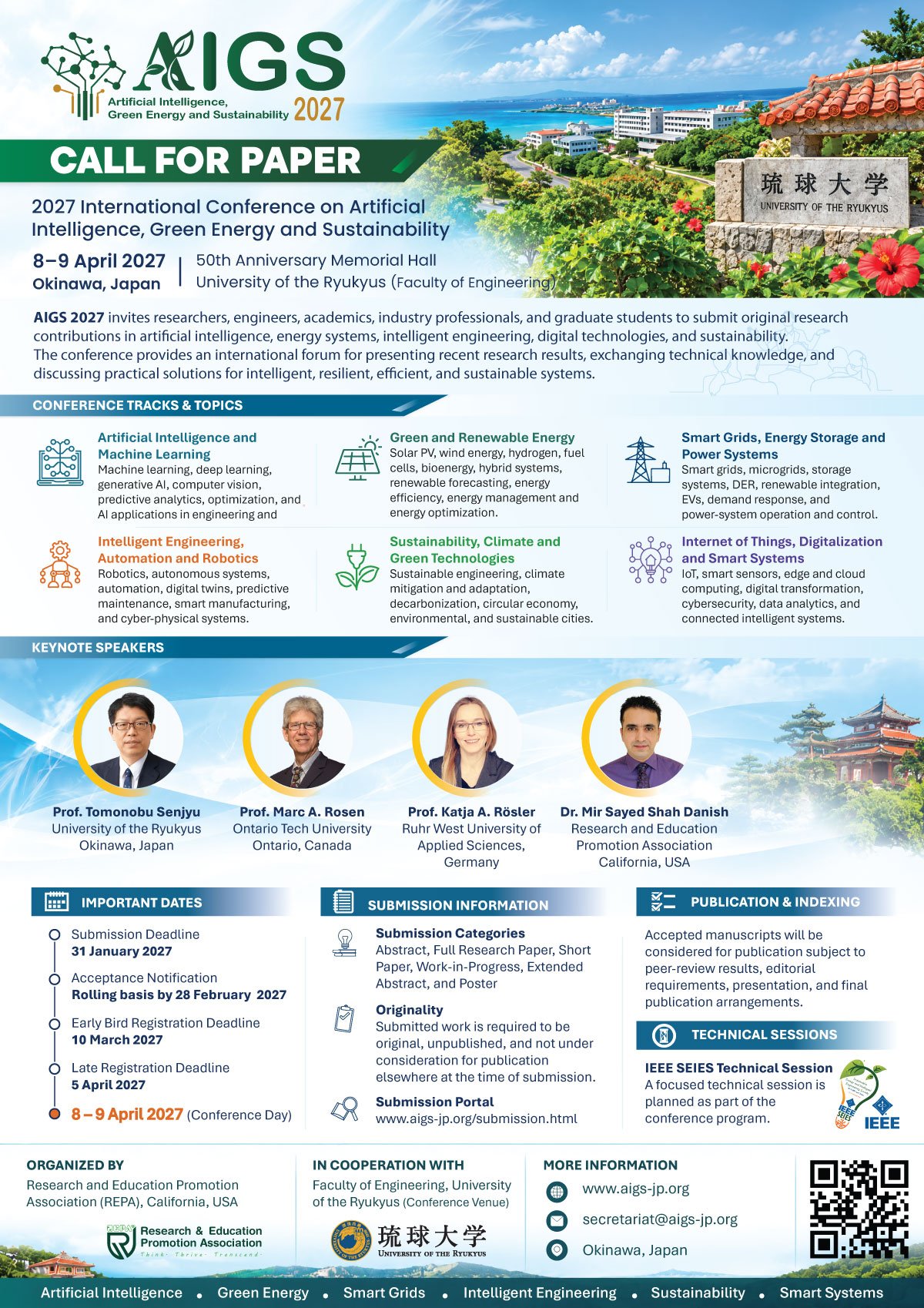
Conference Themes & Research Tracks
- Machine learning, deep learning, and generative AI
- Responsible, trustworthy, and explainable artificial intelligence
- Natural language processing, computer vision, and multimodal AI
- Reinforcement learning, intelligent optimization, and decision systems
- Predictive analytics, big data, and data-driven modeling
- AI agents, autonomous intelligence, and emerging AI applications
- AI-enabled healthcare, education, agriculture, and business applications
- Computational intelligence for engineering, energy, and sustainability
- Solar energy, photovoltaics, and advanced renewable technologies
- Wind, ocean, geothermal, and hydroenergy systems
- Green hydrogen, fuel cells, and alternative energy carriers
- Bioenergy, biomass, and waste-to-energy technologies
- Hybrid renewable systems and distributed energy generation
- Energy conversion, efficiency, and sustainable energy utilization
- AI-driven renewable energy forecasting, monitoring, and optimization
- Clean energy innovation, deployment, and sustainable energy transitions
- Smart grids, microgrids, and distributed energy resources
- Battery technologies, advanced storage, and energy management
- Power-system planning, operation, protection, and intelligent control
- Demand response, smart metering, and electricity markets
- Electric vehicles, electrification, and charging infrastructure
- Power electronics, renewable integration, and grid modernization
- Power-system reliability, cybersecurity, and infrastructure resilience
- AI, machine learning, and digital twins for intelligent energy systems
- Intelligent engineering design, modeling, and optimization
- Robotics, autonomous systems, and intelligent machines
- Industrial automation, adaptive control, and smart manufacturing
- Industry 4.0, Industry 5.0, and human-centered technologies
- Cyber-physical systems, mechatronics, and intelligent instrumentation
- AI-enabled predictive maintenance and industrial monitoring
- Smart sensors, human-robot interaction, and collaborative automation
- Sustainable engineering applications and resource-efficient technologies
- Climate-change mitigation, adaptation, and environmental resilience
- Decarbonization, net-zero technologies, and sustainable development
- AI-driven environmental monitoring, modeling, and climate prediction
- Green buildings, sustainable infrastructure, and intelligent transportation
- Circular economy, resource efficiency, and life-cycle assessment
- Smart agriculture, food security, and intelligent water management
- Sustainable ecosystems, biodiversity, and environmental protection
- Social, economic, and institutional sustainability supported by smart technologies
- Internet of Things, Industrial IoT, and intelligent sensor networks
- Smart cities, smart buildings, and connected communities
- Digital twins, cyber-physical systems, and intelligent infrastructure
- Edge computing, cloud computing, and distributed intelligence
- Big data analytics, blockchain, and secure digital technologies
- Smart healthcare, digital education, and AI-enabled public services
- Intelligent mobility, smart logistics, and digital energy platforms
- AI-driven digital transformation, governance, and community resilience
Previous Conference Publication Successfully Indexed in Scopus
Our previous conference, CEGS 2024, achieved an important academic publishing milestone through its associated Springer Nature publication, which is indexed in the Scopus database.
This achievement reflects our experience in supporting scholarly publication and the dissemination of research through recognized academic publishing channels. The official Scopus record is available for independent verification.
Verify Previous Conference Publication on Scopus

Scopus EID: 2-s2.0-85207213453
Click the image to view the official Scopus record.
Important Dates
| Event / Deadline | Date |
|---|---|
| Submission Deadline | January 31, 2027 |
| Final Deadline for Revised Paper Submission | February 15, 2027 |
| Acceptance Notification | Rolling basis; all remaining final decisions by February 28, 2027 |
| Registration Deadline | March 10, 2027 |
| Final Conference Program Announcement | March 25, 2027 |
| Conference | April 8–9, 2027 |
Submission Categories & Guidelines
AIGS 2027 invites original scientific and technical contributions in two submission categories: full research papers and research abstracts. English is the official language of submission. Contributions are required to demonstrate relevance to the conference scope, scientific or technical merit, methodological clarity, and originality. All submissions are subject to academic evaluation in accordance with the conference review procedures.
- Full Research Paper: The recommended manuscript length is 6–20 pages. Papers are required to present clearly defined research objectives, appropriate methodology, results, scientific analysis, conclusions, and relevant references.
- Research Abstract: Abstracts are required to contain 250–400 words, presenting the research objectives, methodology, principal findings, scientific contribution, and significance of the study.
- Research Originality: Submitted contributions are required to represent original scholarly work, include appropriate citations and acknowledgments, and comply with established principles of research ethics and academic integrity.
- Scientific Evaluation: Full research papers normally undergo single-blind review. Research abstracts undergo scientific and technical assessment based on originality, relevance, methodological adequacy, research quality, and suitability for conference presentation.
- Conference Presentation: Accepted contributions are scheduled for oral, poster, or online presentation, as determined by the conference program, submission category, and applicable participation arrangements.
- Publication Consideration: Selected accepted and presented contributions may be considered for post-conference publication through academic proceedings or scholarly journals. Publication decisions remain subject to scientific evaluation, editorial approval, manuscript quality, and the requirements of the respective publication outlet.
Why Submit to AIGS 2027?
- International Research Visibility: Present original scientific research and innovative findings to an international academic audience, strengthening research visibility and scholarly exchange.
- Publication Opportunities: Selected papers may be considered for academic conference proceedings or affiliated journals, subject to editorial approval and publication requirements.
- Research Recognition: Outstanding scientific contributions and conference presentations may receive Best Paper and Best Presentation Awards, recognizing academic excellence.
- Flexible Participation: Present accepted research in person in Okinawa, Japan, or through available online presentation arrangements, supporting international participation.
- Conference Documentation: Official conference invitation letters are available to eligible registered participants following payment confirmation and administrative verification.
How to Submit Your Research?
Authors are invited to review the submission guidelines and select the appropriate submission category. Research abstracts and full papers are submitted through their respective online submission systems.
- Full Research Papers: Full papers are submitted through the official AIGS 2027 EasyChair conference management system, following the published author guidelines.
- Research Abstracts: Abstracts are submitted through the dedicated AIGS 2027 online submission and evaluation system, accessible through the official Submission page.
- Submission Confirmation: Authors are advised to retain their submission reference and monitor official communications regarding evaluation outcomes, revisions, and acceptance decisions.
Selected Springer Publications from Previous Conferences
Previous academic conferences and scholarly initiatives have contributed to Springer publications covering sustainable energy, artificial intelligence, engineering, environmental research, and interdisciplinary sustainability. The following books illustrate established publication outcomes from earlier events.

Click cover to enlarge
Unified Vision for a Sustainable Future
A Multidisciplinary Approach Towards the Sustainable Development Goals
- Publisher: Springer Nature (Springer Cham)
- Editor: Mir Sayed Shah Danish
- Conference: CEGS 2024
- Publication Year: 2024
- ISBN: 978-3-031-53576-5
- DOI: 10.1007/978-3-031-53574-1
- Research Focus: Sustainable energy, AI-enabled power systems, environmental sustainability, interdisciplinary research, and the Sustainable Development Goals
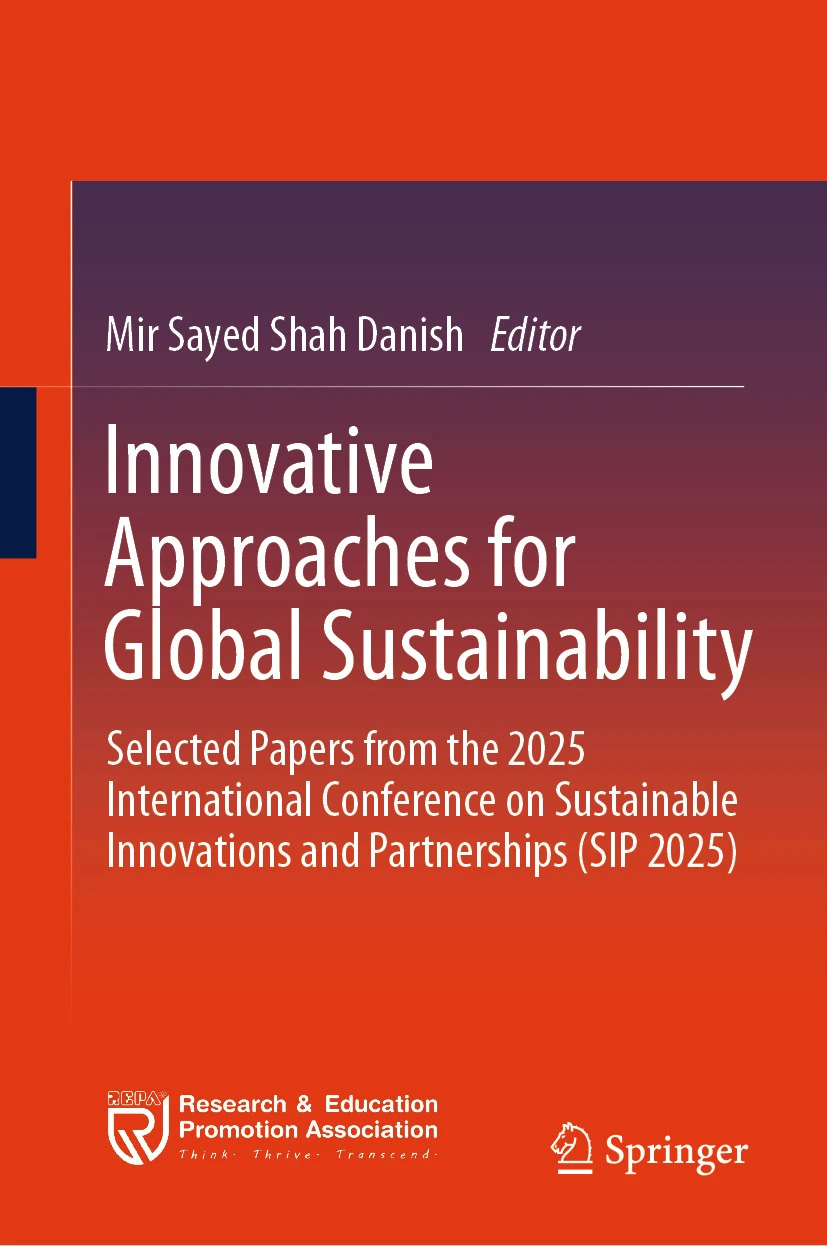
Click cover to enlarge
Innovative Approaches for Global Sustainability
Selected Papers from the 2025 International Conference on Sustainable Innovations and Partnerships (SIP 2025)
- Publisher: Springer Nature (Springer Cham)
- Editor: Mir Sayed Shah Danish
- Conference: SIP 2025
- Publication Year: 2026
- ISBN: 978-3-032-18040-7
- DOI: 10.1007/978-3-032-18038-4
- Research Focus: Sustainability, renewable energy, smart infrastructure, AI applications, climate resilience, and interdisciplinary scientific innovation